
Refinement is the essence of curation
Most people misunderstand curation.
They think curation means saving links, bookmarking pages, or collecting information for later use. In reality, that behavior creates digital clutter, not knowledge.
Curation is not about saving and forgetting.
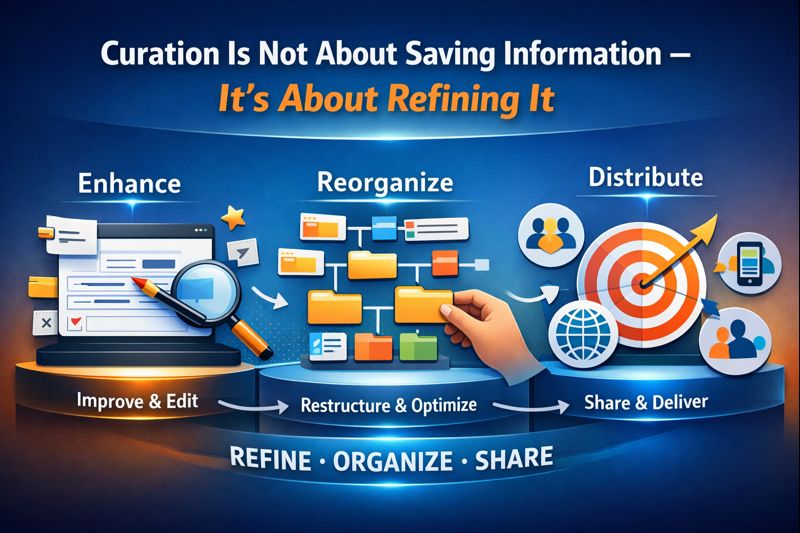
Curation is about continual refinement—enhancing what you save, reorganizing it as needs change, and distributing it in ways that make information usable by others.
A good curation tool doesn’t just store information.
It gives curators the ability to shape, improve, restructure, and reuse knowledge over time.
This article explains why refinement—not storage—is the defining principle of effective curation, and why modern tools like Kurator are designed around this philosophy.
What Curation Really Means (and Why Most Tools Get It Wrong)
Content curator Robing Good in his post: Why is the Content Curator the key emerging editorial role of the future, says
“A content curator is someone who continually finds, groups, organizes and shares the best and most relevant content on a specific issue online.”
The most important word in that definition is continually.
Curation is not a one-time action. It is an ongoing process that reflects:
-
Changing information
-
Evolving understanding
-
Real-world usage patterns
-
The needs of the people consuming the information
Most traditional tools fail because they treat information as static.
They assume structure can be designed once and remain useful forever.
That assumption doesn’t hold up in real operational environments.
The Core Problem: Saving Information Without Refinement
Across organizations and individuals alike, the same pattern emerges:
-
People save useful information
-
The volume grows quickly
-
Context is lost
-
Structure becomes outdated
-
Retrieval slows down
-
Knowledge becomes fragmented
Traditional bookmarking systems, portals, and file hierarchies were never designed to support continuous refinement.
They focus on:
-
Storage instead of usability
-
Fixed structures instead of adaptive organization
-
Centralized control instead of curator-driven evolution
As a result, information becomes harder—not easier—to find over time.
Why Refinement Is the Essence of Curation
Curation becomes valuable only when saved information can be:
-
Enhanced
Titles clarified, descriptions improved, summaries added, context preserved. -
Reorganized
Information regrouped as understanding evolves, projects change, or new patterns emerge. -
Distributed
Shared in targeted ways—by topic, project, role, or audience—without duplication or rework.
Without these capabilities, saving information is just hoarding.
Refinement turns saved content into usable knowledge.
A Real-World Case Study in Continuous Curation
Years before “curation” became a mainstream concept, a long-term enterprise case study with our tools revealed this exact dynamic.
In a two-year operational study conducted within an information-intensive organization in London, four functional teams—Medical, Travel, Claims, and Legal—were responsible for managing hundreds of evolving information sources.
Each group needed:
-
Fast access to accurate information
-
Personalized structures aligned to their workflows
-
The ability to adapt content organization without technical bottlenecks
Traditional portals failed because structure was “designed in” and difficult to change.
What worked instead was a curator-driven system—one that allowed users themselves to continuously reorganize information based on real usage.
Over time, each team refined:
-
Taxonomy
-
Grouping logic
-
Navigation patterns
-
Contextual relevance
The result was not just better access—but better understanding.
The Hidden Cost of Fixed Information Structures
One of the biggest failures of traditional information systems is the assumption that structure is permanent.
In reality:
-
What makes sense today may not make sense in three months
-
New users think differently than original designers
-
Operational pressure exposes flaws no blueprint can predict
When refinement is difficult or restricted:
-
Training takes longer
-
Errors increase
-
Knowledge becomes siloed
-
Publishing slows down
-
IT dependency grows
The real cost isn’t inefficiency—it’s lost momentum.
How Curator-Led Refinement Changes Outcomes
When refinement is built into the curation process, several things happen:
-
Information reflects real-world usage, not theoretical design
-
Taxonomy evolves naturally through feedback
-
Knowledge becomes easier to find for new users
-
Publishing speed increases dramatically
-
Editorial control shifts from specialists to practitioners
In the case study, curator-led refinement reduced onboarding time by more than half and cut publishing cycles from days to hours.
Not because more content was added—but because existing content became easier to access and understand.
Kurator: Built for Refinement, Not Just Storage
Kurator is designed around a simple principle:
Saved information must remain editable, reorganizable, and distributable.
Instead of locking information into rigid structures, Kurator enables curators to:
-
Enhance saved content immediately
-
Apply evolving metadata and context
-
Reorganize collections without friction
-
Share curated knowledge without duplication
-
Adapt structures as needs change
This makes curation a living process, not a static archive.
Kurator treats curation as an ongoing dialogue between information and its users.
The True Value of Curation
The value of curation shows up in two measurable areas:
1. Time Savings
-
Faster onboarding
-
Reduced search time
-
Quicker publishing cycles
-
Less dependency on technical staff
2. Knowledge Transfer
-
Better understanding, not just access
-
Consistent information across teams
-
Editorial control in the hands of practitioners
-
Context preserved instead of lost
When refinement is continuous, curated knowledge compounds in value instead of decaying.
Editorial Control Belongs to Everyday Users
One of the most overlooked benefits of modern curation tools is democratized editorial control.
Historically, structuring and publishing information required:
-
Developers
-
Portal designers
-
Specialized IT roles
Refinement-based curation shifts that power to:
-
Researchers
-
Project leads
-
Subject-matter experts
-
Teams closest to the work
This is not just a productivity gain—it’s a cultural shift.
Key Takeaways: What Effective Curation Requires
-
Curation is an ongoing process, not a one-time action
-
Saving information without refinement creates clutter
-
Structure must be adaptable, not fixed
-
The best curation reflects real usage, not theoretical design
-
Tools must support enhancement, reorganization, and distribution
-
Editorial control should live with the people using the information
Final Thought
Curation tools exist to help people find what they need faster and with greater clarity.
But the tools that deliver lasting value are the ones that treat refinement as a core philosophy—not an afterthought.
When refinement is built in, curation becomes more than organization.
It becomes knowledge in motion.