
The Power of Consistency: How Template-Based Management Transforms Your Information Strategy
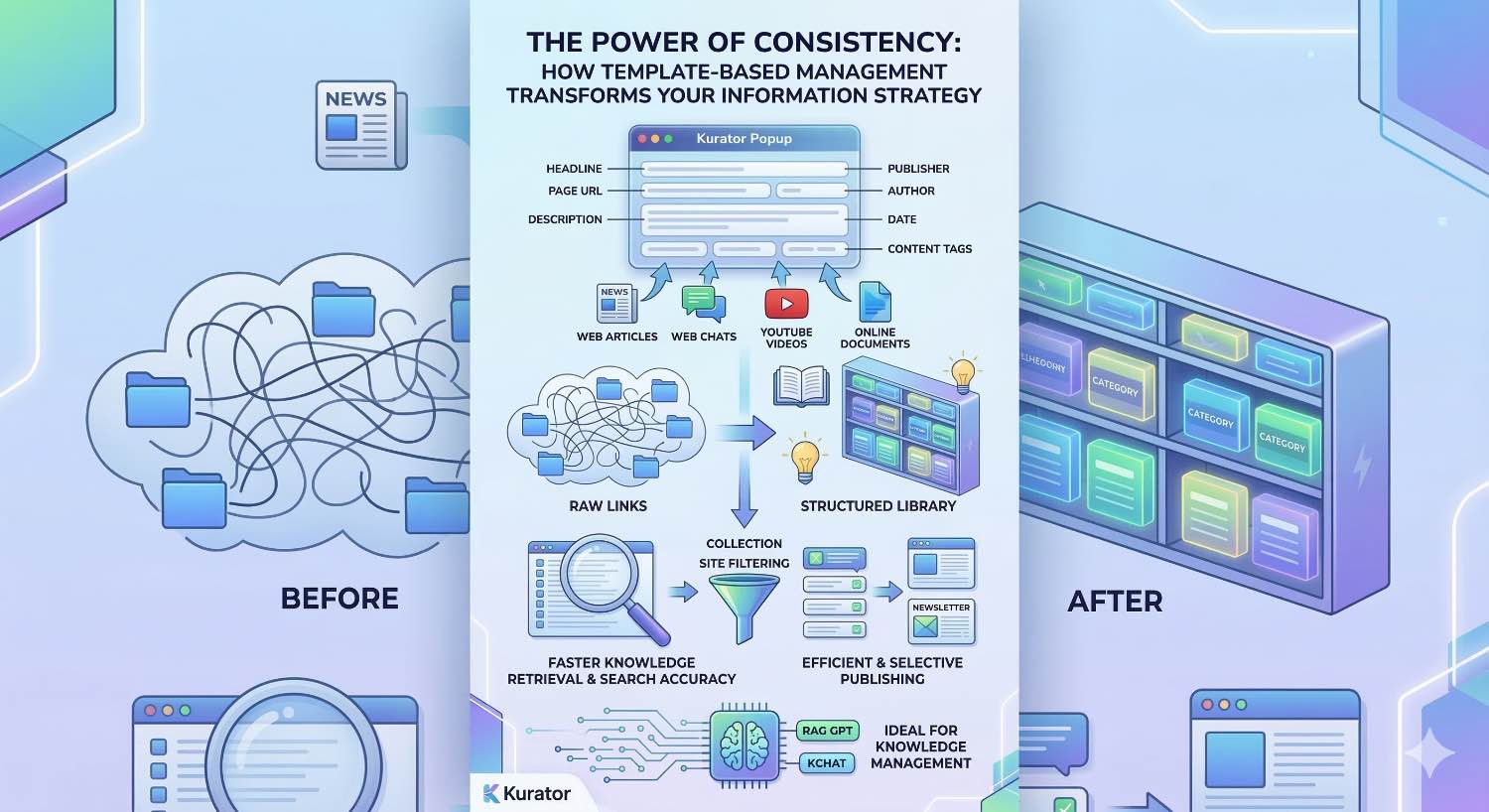
In an era defined by what experts call “information obesity,” the challenge facing modern professionals is no longer a lack of access to data.
On the contrary, we are drowning in it.
The real struggle lies in capturing, organizing, and – most importantly – retrieving that information before it vanishes into the digital abyss of forgotten tabs and broken bookmarks.
Most of us treat our browsers like a digital junk drawer: a chaotic pile of “read later” links that are never actually read, let alone utilized for business value.
This lack of structure leads to “knowledge leakage,” where valuable insights discovered by one team member are lost to the rest of the organization.
Kurator changes this dynamic by shifting the focus from passive bookmarking to Template-Based Knowledge Management.
By applying a structured creator schema to every piece of data you save, Kurator transforms a messy web of links into a high-powered, searchable, and publishable research library.
Why Template-Based Knowledge Management is the Future of Research
At the heart of Kurator is a simple but revolutionary concept: the Kurator Popup.
This isn’t just a “save” button; it is a dynamic template designed for professional-grade research and knowledge retention.
When you encounter a valuable piece of information, the Kurator popup appears as your data entry gateway.
It forces a moment of intentionality.
Instead of just grabbing a URL and hoping you’ll remember why you saved it, Kurator uses a standardized Creator Schema.
Whether you are saving a deep-dive technical article, a complex web chat, a YouTube tutorial, or an internal Google Doc, Kurator stores it using a consistent set of attributes:
- Headline: The core title of the information, often pre-filled but fully editable to match your internal terminology.
- Page URL: The permanent home of the resource, ensuring you can always return to the source.
- Image: A visual anchor. Humans process images 60,000 times faster than text; having a visual thumbnail makes scanning your library significantly faster.
- Description: A summarized context. This is where you record the “Why”—why does this link matter to your current project?
- Publisher & Author: Critical for citing sources, tracking thought leaders, and establishing the authority of the information.
- Date: Establishing the freshness of the data, which is vital in fast-moving industries like tech or finance.
- Content Tags: Your personal or organizational taxonomy for cross-functional categorization.
By using this template, you ensure information consistency and accuracy. You aren’t just saving a link; you are indexing a knowledge asset that can be used by anyone in your organization.
Join Our Newsletter
Smart Information Indexing: Leveraging the Creator Schema for Custom Content
While the structure of Kurator is rigid enough to ensure order, it is flexible enough to accommodate your unique workflow.
One of the greatest knowledge management benefits of Kurator is the ability to adapt the template fields to the type of content you are consuming.
This is where you can apply your own creativity when saving links.
The AI Transformation
In the age of generative AI, our "sources" have changed. We are no longer just reading articles; we are having sophisticated dialogues with machines.
When saving an insightful ChatGPT, Claude, or Gemini thread, you can adapt the Kurator template to capture the metadata of the interaction:
- Publisher: Instead of a news site, use this field for the "Source App" (e.g., chatGPT).
- Author: Use this for the specific "Custom GPT" or the version of the model (e.g., GPT-4o) used to generate the response.
Video and Document Management
When saving a YouTube tutorial, the "Publisher" becomes the channel name.
When saving a Google Doc or a Notion page, the "Author" becomes the internal project lead.
This creative application of the schema allows you to build a Structured Content Management system that bridges the gap between traditional media, internal documentation, and the new frontier of generative AI.
Maximizing Knowledge Retrieval Efficiency with Collection and Site Filtering
The ultimate goal of any management system is knowledge retrieval efficiency.
It doesn’t matter how much your organization "knows" if that knowledge can’t be found in the "flow of work." Kurator provides two powerhouse features for advanced search capabilities that drastically reduce the time spent hunting for information.
1. Collection Filtering
Your research is likely divided into broad buckets—Marketing, Competitor Analysis, Legal Compliance, or AI Trends.
Kurator allows you to isolate these "Collections" so you aren't digging through your entire life's work to find one specific document. This compartmentalization is key to maintaining focus.
2. Site Filtering
Often, our brains remember where we saw something, even if we can't remember exactly what it was called.
Kurator’s site filtering allows you to drill down into specific domains within a collection.
- Scenario: You remember seeing a great SEO tutorial on YouTube three months ago. Instead of searching all 2,000 links in your "Marketing" collection, you simply filter by "youtube.com." Instantly, the noise disappears, and you are left with only the video assets you've curated.
This level of smart information indexing ensures that "search" isn't a frustrating fishing expedition - it’s a precision strike that saves hours of billable time every month.
Improved Operational Efficiency: Moving from Information Curation to Selective Publishing
How does this translate to Improved Operational Efficiency? In a typical business environment, employees spend up to 20% of their time just looking for information.
For a team of ten, that is the equivalent of two full-time employees' worth of productivity lost to the "search vacuum."
By implementing a template-based system:
- Onboarding is Accelerated: New hires can step into a "Collection" and see the history of a project, complete with descriptions and context, rather than a list of raw URLs.
- Redundancy is Eliminated: Teams stop paying for research that has already been done. If a competitor analysis has already been curated in Kurator, the next person doesn't have to start from scratch.
3. Accuracy is Guaranteed: Because the template captures the "Date" and "Author," teams are less likely to rely on outdated or unverified information, reducing the "cost of error."
The Power of Consistency: Easy to Find, Easy to Publish
A consistent, template-based structure doesn't just help you find information; it makes it remarkably easy to share and publish it. This is a critical component of faster time to market for digital projects.
Because every item in your Kurator collection shares the same metadata (Image, Headline, Description), you can publish these collections to the web as curated hubs or newsletters instantly.
However, the true power lies in selective publishing.
Content Filters for Selective Publishing:
Kurator allows you to use your content tags and filters to select a specific subset of a collection for publishing.
- Example: Below I have published a section of my Kurator tutorials, filtered by use cases. As I create new videos on this topic, they will be automatically added to the carousel below, turning a static blog page to a dynamic information portal
This workflow eliminates the need for manual copy-pasting your posts into your CMS systems. The data was "pre-formatted" the moment you saved it in the Kurator popup and is pushed to your website.





Building a Better RAG GPT: The Role of Structured Knowledge Management
Most RAG (Retrieval-Augmented Generation) solutions suffer from a "data swamp" problem.
They rely on complex, expensive algorithms to extract meaning from unstructured files, often leading to hallucinations or irrelevant context retrieval.
Our KChat solution takes a different approach by leveraging Kurator’s structured knowledge base.
Instead of starting from scratch with raw data, KChat utilizes a pre-organized architecture that significantly improves performance in three ways:
1. Precision Retrieval through Metadata
While standard RAG searches only for semantic similarity (vectors), KChat uses Kurator’s structured fields to apply Metadata Filtering. This means the AI doesn't just look for "similar words"—it can pinpoint answers based on specific categories, tags, or authors defined in Kurator.
2. Efficient Incremental Syncing
Because Kurator maintains a Date Modified field for every post, KChat’s vectorization process is purely incremental. We don't re-index the entire library; we perform high-watermark Upserts.
- New Content: Appended instantly.
- Modified Content: Updated by matching unique Post IDs.
- Result: A knowledge base that is always current without the "re-indexing" lag time.
3. Structural Consistency
Most GPT solutions spend massive compute power trying to "chunk" and "label" data on the fly.
Kurator provides a consistent schema from the start. This structured architecture gives KChat a clear map to find answers, ensuring that the retrieved context is high-signal and low-noise.
The bottom line: By syncing KChat with Kurator’s curated environment, we aren't just giving the AI more data - we’re giving it better instructions.
You can try KChat on this page (bottom right corner) to see how our tools work together.
Conclusion: Transform Your Information Strategy
Adopting template-based knowledge management with Kurator is more than just a software choice; it is an investment in your organization's intellectual capital.
By moving away from "loose links" and toward a "structured schema," you unlock:
- Unrivaled Consistency: A unified way for every team member to interact with digital assets.
- Lightning Speed: Retrieval that takes seconds, enabling real-time decision-making.
- AI Readiness: A data pipeline that is ready to power the next generation of RAG-based tools.
In the modern business landscape, the person (or company) with the best-organized information wins.
Don't just bookmark the web - curate it.
Enhance your operational efficiency, reduce costs, and lead your industry with the power of structured knowledge.